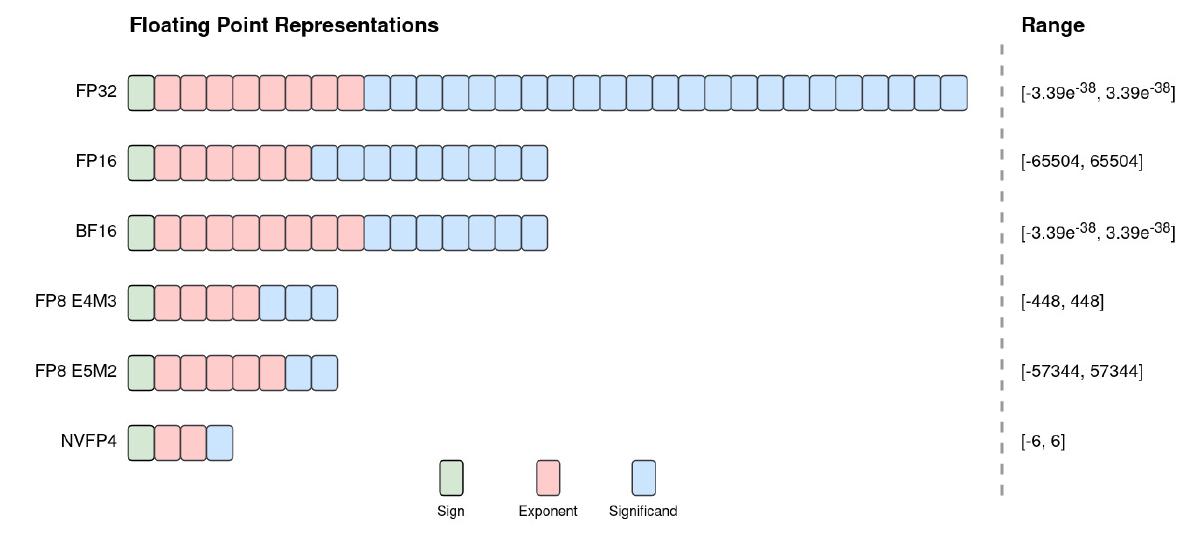

Neural networks are usually trained and stored using 32-bit floating-point numbers. That precision is useful during training, but it can be expensive during inference. Representing a model with FP16 or INT8 values can reduce its size, lower memory bandwidth requirements and speed up inference on hardware that supports low-precision computation.
Reducing precision is not free. Values must be rounded or clipped to a smaller set of representable numbers, introducing errors that can accumulate as data moves through the network layers. The resulting speed-up also depends on the model, runtime and hardware. A smaller model is not automatically a faster one.
In this article, I will start with floating-point representation and affine quantization, then explain post-training quantization, dynamic and static INT8 quantization, and quantization-aware training. Finally, I will compare FP32, FP16 and INT8-enabled TensorRT engines for MobileNetV2, looking at engine size, batch-one inference latency, classification accuracy and intermediate feature maps.
Background#
Before diving into application details, we must first understand floating point representation and the basic neural network quantization scheme.
Numerical Representation#
Computers represent numbers as sequences of bits. A signed \(N\)-bit integer is represented using Two’s Complement:
$$ \text{int}_N = -b_{N-1}2^{N-1} + \sum_{n=0}^{N-2}b_n2^n $$where the most significant bit (MSB) \(b_{N-1}\) has a negative weight. When the MSB is \(0\), the integer is positive, and when the MSB is \(1\), \(2^{N-1}\) is subtracted from the binary sum, pulling it into the negative range. This allows for the same hardware logic to be used for both addition and subtraction, which is highly efficient.
Floating-point numbers follow the IEEE-754 standard. Their representation can be conceptualized as normalized binary scientific notation:
$$ y = (-1)^S\times(1+f) \times 2^{E - B} \\ 0 \le f < 1, \ \ \ \ E, \ B \in \mathbb{N} $$- \(S\): Sign. A single bit determining if the sign is positive or negative.
- \(f\): Fraction. The fractional part of the significand. The significand is normalized in binary, so the leading \(1\) is assumed and thus we do not need a bit to store it.
- \(E - B\): \(E\) is the unsigned value stored in the exponent field, while \(B\) is a fixed bias. The effective exponent is \(E-B\), allowing both positive and negative exponents to be represented without storing a separate sign bit.
For normalized finite values, in terms of bits, the float value is:
$$ \text{fp}_N = (-1)^{b_{N-1}} \times 2^{E - B}\times \left(1+\sum_{n=1}^{M}b_{M-n}2^{-n}\right) $$where
$$ E = \sum_{n=0}^{K-1}b_{M+n}2^n, \ \ \ B = 2^{K-1}-1, \ \ \ N = K + M + 1 $$- \(N\): Total bits.
- \(K\): Exponent bits.
- \(M\): Fraction bits.
For example, a 32-bit floating point (FP32) number has \(N=32, \ K = 8, \ M = 23\) and a 16-bit floating point (FP16) number has \(N=16, \ K = 5, \ M = 10\).
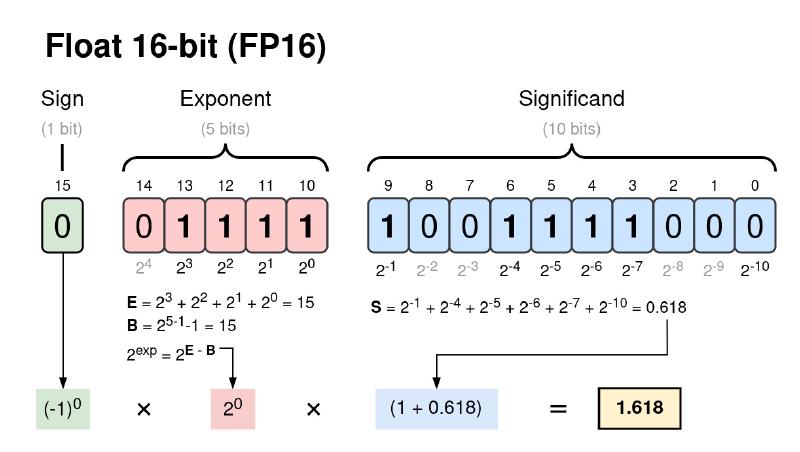
Figure 1: The number 1.61803 represented as a 16-bit floating point.
For normalized FP16 values in the interval \([1,2)\), adjacent representable numbers are separated by
$$ 2^{-10}=0.0009765625 $$This spacing scales with the exponent across the FP16 range, so FP16 provides roughly three significant decimal digits of precision.
Common floating-point formats used in machine learning (ML), include FP32, FP16, BF16 and FP8.
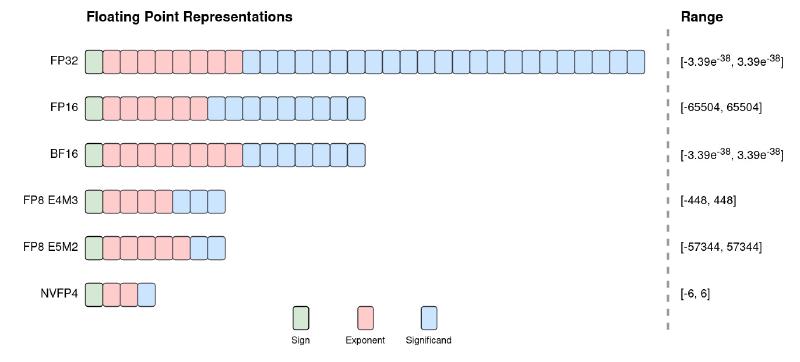
Figure 2: Common floating-point formats used in machine learning.
Quantization Basics#
Quantization is the process of mapping a large set of values onto a smaller, discrete set. The widely-adopted modern standard for neural networks was described by Jacob et al. in their seminal 2018 paper. They introduced an affine quantization scheme that enables integer-only neural-network inference.
To map a floating-point value \(x \in [\alpha, \beta]\) to an integer value \(x_q \in [\alpha_q, \beta_q] \cap \mathbb{Z}\), we quantize \(x\) as follows:
$$ x_q = Q(x) = \text{clip}\left(\text{round}\left(\frac{x}{s}\right)+z, \alpha_q, \beta_q\right) $$Where:
- \(s\): Scale. A positive float that defines the step-size of the integer grid.
- \(z\): Zero-point. An integer that represents exactly \(0.0\) in the integer space. This is necessary, because \(0.0\) is frequently used in neural network array padding, so an inexact mapping would result in an accuracy drift.
- \(\text{clip}(y, a, b) = \text{min}(\text{max}(y, a), b)\)
To convert \(x_q\) back into a floating point value \(\bar{x}\), we dequantize it with
$$ \bar{x} = D(x_q) = s(x_q-z), \ \ \ x = \bar{x} + \epsilon_q $$where \(\epsilon_q\) is quantization error due to rounding.
Since \([\alpha,\beta] \rightarrow [\alpha_q,\beta_q]\) and \(Q(0) = z\), we can solve for \(s\) and \(z\):
$$ \begin{align} s &= \frac{\beta - \alpha}{\beta_q - \alpha_q}\\ z &= \text{round}\left(\frac{\alpha_q\beta - \alpha\beta_q}{\beta - \alpha}\right) \end{align} $$Note: If the real-valued range is chosen as \([-a,a]\) and mapped to a signed integer range centred around zero, it lets the zero-point be fixed at \(z=0\). This is known as symmetric quantization, a simplified version of affine quantization which has many performance benefits. We will discuss this type of quantization later.
Quantizing Neural Networks#
In ML, FP32 is the standard format. Its large dynamic range reduces the risk of gradient overflow and underflow, and its precision is high enough to capture tiny gradient updates during backpropagation.
However, the bits add up quickly. An LLM with 70 billion parameters stored in FP32 requires 280 GB of memory just to load the weights. Performing trillions of floating-point operations (FLOPs) with these large values is impractical even on high-end edge devices.
The goal of quantization is to reduce a model’s memory footprint and increase its throughput by converting it to a lower-precision format. Since this process is lossy, it may degrade the model’s accuracy. Thus, the primary engineering challenge of quantization is balancing the performance gains against the fidelity requirements of the application.
Float Casting#
Let’s ease ourselves into this challenge with float casting: converting FP32 values to lower-precision formats such as FP16 or BF16. While technically not quantization, casting to FP16 is an effective way to decrease a model’s size and potentially accelerate its inference on GPUs with optimized Tensor Cores.
FP16 is often accurate enough for inference, but it has a much smaller dynamic range than FP32, which can lead to numerical instability. BF16 was introduced by Google Brain to circumvent this issue. It preserves the same dynamic range as FP32 with an 8-bit exponent, but loses some precision due to a shorter fraction.
Post-Training Quantization#
Quantizing a trained model is known as post-training quantization (PTQ). Both weights and activations can be quantized, but let’s consider the weights first. Since weights are frozen after training, we can calculate their quantization parameters offline.
Recall the general formulas:
$$ \begin{align} x_q &= \text{clip}\left(\text{round}\left(\frac{x}{s}+z\right), \alpha_q, \beta_q\right)\\ \bar{x} &= s(x_q-z) \end{align} $$where
$$ \begin{align} s &= \frac{\beta - \alpha}{\beta_q - \alpha_q}\\ z &= \text{round}\left(\frac{\alpha_q\beta - \alpha\beta_q}{\beta - \alpha}\right) \end{align} $$Before calculating \(s\) and \(z\) we must select the quantization granularity, meaning which groups of weights will share the same quantization parameters.
- Per-tensor: All values in one weight tensor use the same \(s\) and \(z\). This is memory-efficient but can introduce large errors if the data distribution is skewed.
- Per-channel: Every channel in a tensor (e.g. a filter in a convolution layer) has its own parameters. This isolates outliers to a single channel, reducing their impact on the tensor.
- Per-block: Divides the tensor into smaller blocks, each with its own \(s\) and \(z\). This method can reduce quantization error, especially in tensors with irregular distributions, but it increases memory overhead.
Once the granularity is chosen, we must determine the floating-point range \([\alpha, \beta]\) of the weight tensor. Common algorithms include:
- MinMax: \(\alpha = \text{min}(w), \ \beta = \text{max}(w)\). It is simple, but highly sensitive to outliers.
- AbsMax (Symmetric): \(a = \text{max}(|\text{min}(w)|, |\text{max}(w)|), \ \alpha = -a, \ \beta = a\). This enforces \(z=0\) which simplifies and speeds up computation, but can introduce large errors to asymmetric distributions.
- Percentile: Sets the range to a given percentile, for example \(1\%\) to \(99\%\). This clips outliers to improve the resolution of the in-distribution data.
- Entropy (KL Divergence): Minimizes information loss between the FP32 and INT8 distributions.
Dynamic INT8 Quantization#
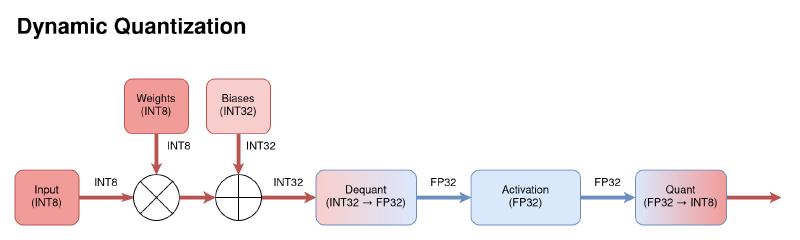
Figure 3: Diagram of the data flow through a dynamically quantized model.
As mentioned earlier, weights embedded in a trained model can be quantized in advance. However, the activations are calculated for each input at runtime and so cannot be quantized offline. In dynamic quantization, weights are quantized ahead of time, while activation ranges and quantization parameters are calculated from the current input at runtime. Supported operations can then use integer arithmetic with INT32 accumulation before converting their output back to the format expected by the next operation. Calculating activation parameters at runtime avoids calibration but adds computational overhead.
Static INT8 Quantization#
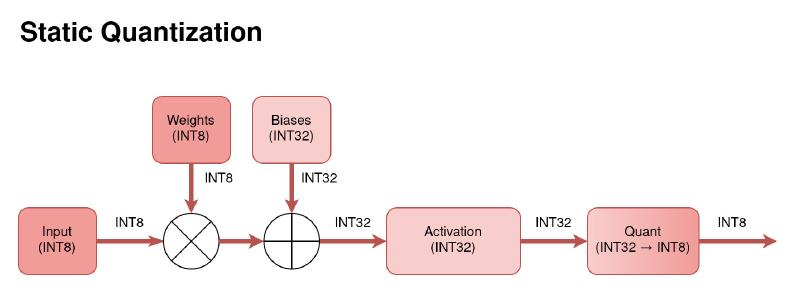
Figure 4: Diagram of the data flow through a statically quantized model.
Static quantization eliminates runtime overhead by quantizing the weights and precomputing fixed scale and zero-point values for the activations. To do this, the model is calibrated by performing inference on a small, representative dataset. Observer functions record the statistics of the activations to pre-calculate fixed \(s\) and \(z\) values. This results in the best performance but requires a good calibration dataset to avoid significant accuracy loss.
Quantization-Aware Training#
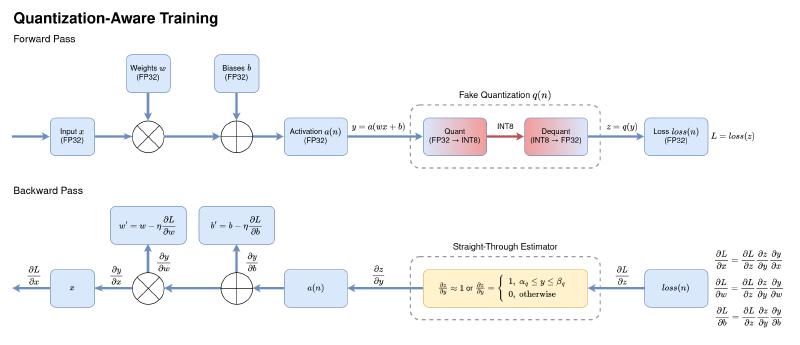
If static PTQ results in an unacceptable accuracy drop, quantization-aware training (QAT) can recover some of that loss. QAT is performed by inserting “fake quantization” nodes into the graph.
During the forward pass, these nodes simulate the rounding and clipping of INT8, thus adding the quantization error to the loss function. During the backward pass, the loss gradients \(\frac{\partial L}{\partial x}, \frac{\partial L}{\partial w}\) and \(\frac{\partial L}{\partial b}\) propagate the quantization error through the network, forcing the weights to adapt to it.
The gradient of the quantization function \(z = q(y)\) is zero almost everywhere, so to avoid propagating it, we use a Straight-Through Estimator (STE). STE typically approximates the gradient as \(1\) (although there are more complex implementations), allowing gradients to flow through the network and getting the model to adapt to the quantization error. As a result, fine-tuning a PTQ model with QAT generally improves accuracy.
MobileNetV2 Example#
Let’s visualize the effects of quantization on a real neural network. I used a pre-trained MobileNetV2 model due to its simple architecture and layer types that quantize easily.
The workflow starts by exporting a pretrained PyTorch MobileNetV2 model to ONNX. I then run the model through ONNX Runtime using the TensorRT Execution Provider. TensorRT builds separate engines with FP32, FP16 or INT8 enabled, selecting suitable kernels and precisions for each layer.
For INT8 calibration, I randomly selected 500 images from the 50,000-image ImageNet-1k validation set. I used a separate random subset of 5,000 images for the latency and classification benchmarks. Calibration used the MinMax method, and all three configurations were evaluated using the same preprocessing and test images.
Note: This example was executed using CUDA 13.2 on the NVIDIA Quadro T1000 Mobile GPU. You can find the full example code in this Jupyter notebook.
First, let’s look at the sizes of the model TensorRT engines.
$$ \begin{array}{lcc} \hline \text{Datatype} & \text{Size (MB)} & \text{Reduction Ratio} \\ \hline \text{FP32} & 14.3 & 1.00\times \\ \text{FP16} & 8.3 & 0.58\times \\ \text{INT8} & \mathbf{4.2} & \mathbf{0.29\times} \\ \hline \end{array} $$Table 1: MobileNetV2 engine sizes across precisions.
The reduction in size from float casting and quantization is very close to the expected \(0.5\times\) and \(0.25\times\). However, the performance benchmarks are underwhelming:
$$ \begin{array}{lccc} \hline \text{Datatype} & \text{Latency (ms)} & \text{Throughput (img/s)} & \text{Speed-Up} \\ \hline \text{FP32} & 2.3318 & 428.85 & 1.00\times \\ \text{FP16} & 2.1898 & 456.67 & 1.06\times \\ \text{INT8} & \mathbf{1.3741} & \mathbf{727.77} & \mathbf{1.70\times} \\ \hline \end{array} $$Table 2: MobileNetV2 latency and image throughput across precisions (ONNX Runtime).
FP16 and INT8 produced smaller gains than I initially expected: \(1.06\times\) and \(1.70\times\) respectively. The main hardware limitation is that the Quadro T1000 Mobile does not have Tensor Cores, so it cannot use the specialized matrix hardware that gives newer NVIDIA GPUs much higher FP16 and INT8 throughput. The benchmark also measures the complete session.run() call at batch size one. This includes ONNX Runtime overhead and transfers between CPU and GPU memory, so these fixed costs can hide some of the gains from lower-precision computation.
Let’s compare the classification results. INT8 reduced top-1 accuracy from \(70.68\)% to \(70.42\)%, a decrease of \(0.26\) percentage points, or approximately \(0.37\)% relative to FP32. Its macro precision, recall and F1 score also decreased, with macro precision showing the largest difference at \(1.03\) percentage points.
$$ \begin{array}{lccc} \hline \text{Datatype} & \text{Accuracy} & \text{Macro Precision} & \text{Macro Recall} & \text{Macro F1-Score} \\ \hline \text{FP32} & 0.7068 & \mathbf{0.7099} & 0.7068 & 0.6826 \\ \text{FP16} & \mathbf{0.7072} & 0.7094 & \mathbf{0.7072} & \mathbf{0.6827} \\ \text{INT8} & 0.7042 & 0.6996 & 0.7039 & 0.6765 \\ \hline \end{array} $$Table 3: MobileNetV2 metrics across precisions.
FP16 produced nearly identical results to FP32. Its top-1 accuracy was 0.04 percentage points higher, corresponding to only two additional correct predictions across the 5,000-image test subset. This difference is too small to support the conclusion that FP16 improved the model. It is better interpreted as effectively unchanged accuracy for this experiment.

Figure 6: Sample image from the test dataset.
But enough numbers. The most compelling evidence of quantization can be seen in the models’ feature maps. In the plots below, the top row shows one channel from a selected intermediate feature tensor for each engine, while the bottom row shows the absolute differences between them.
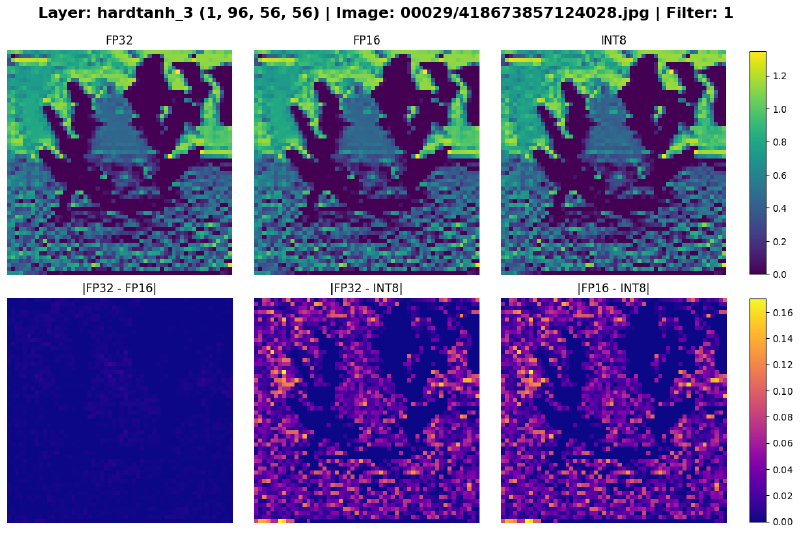
Figure 7: Feature maps of layer “hardtanh_3” for different precisions.
The delta between FP32 and FP16 is very small, whereas INT8 is noticeably different from the two. In this example, the differences remain small in the selected early layers but become more visible in several deeper layers. By the final layers, the models’ divergence can be seen with the naked eye.
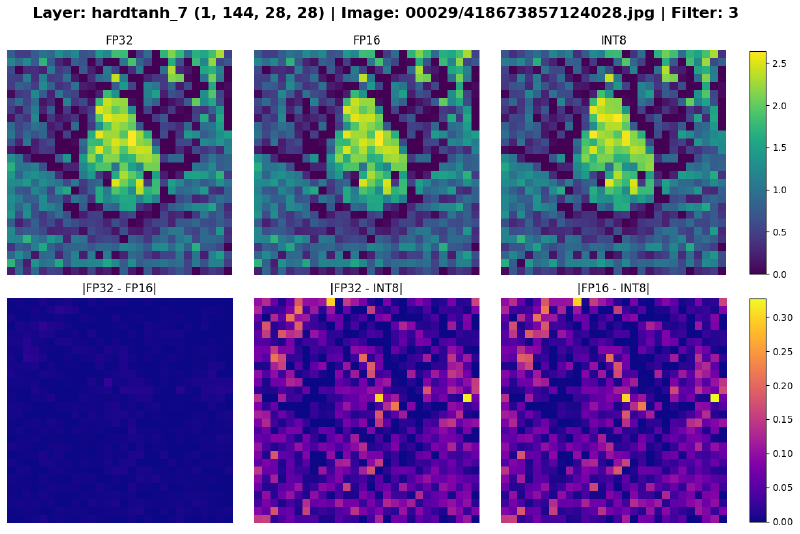
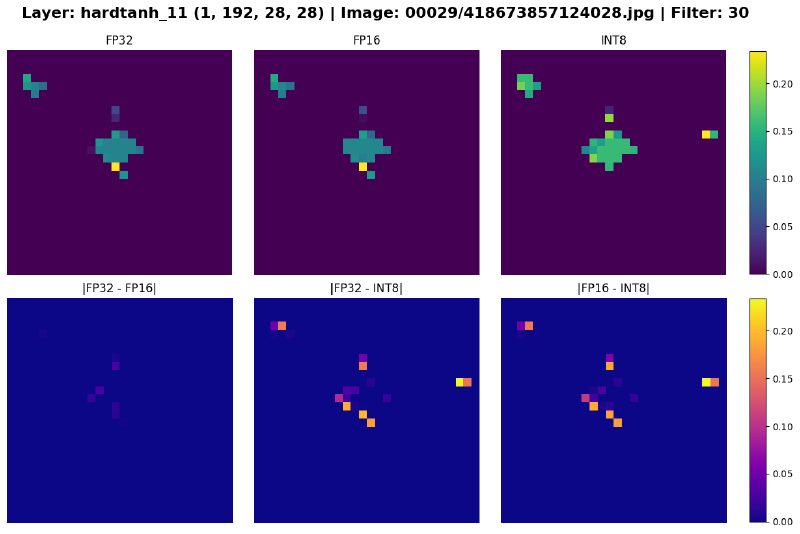
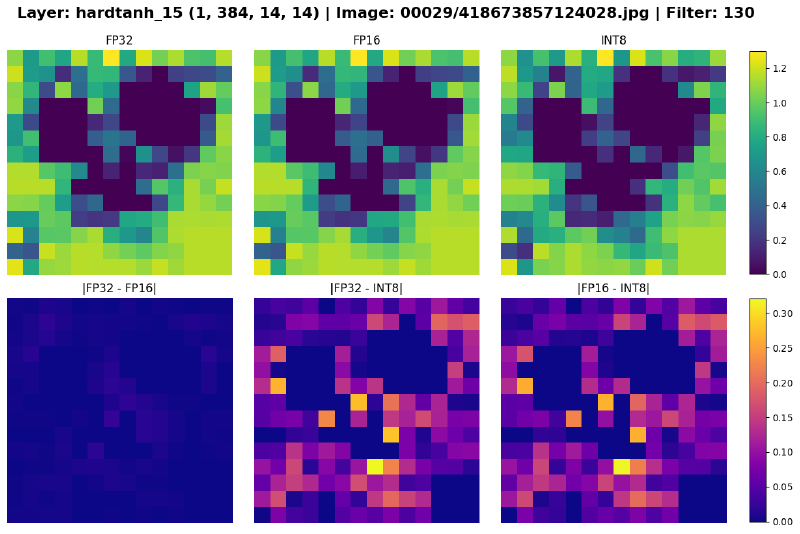
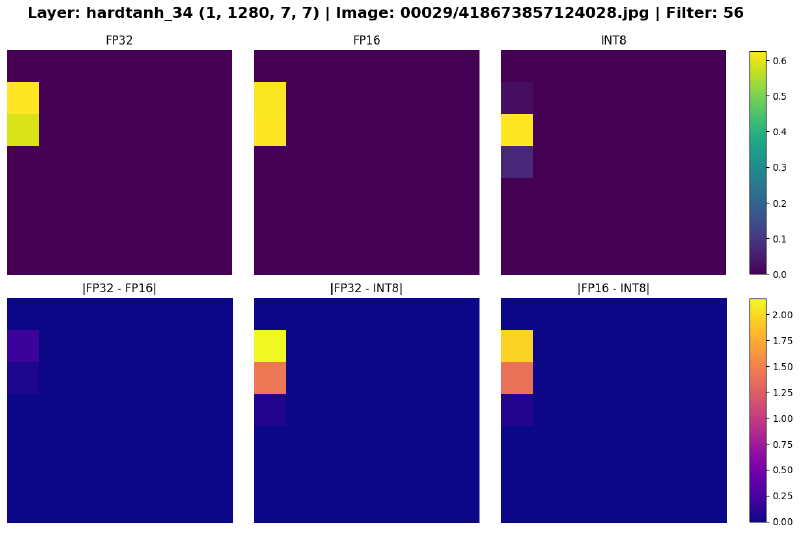
Figure 8: Feature maps of select layers across precisions. The differences are most apparent in the last two plots.
I wish I could have produced more illustrative performance metrics for this example, but unfortunately, my GPU had let me down. Nevertheless, I hope this example helps develop intuition for the outcomes of quantization and demonstrates some execution nuances that may contradict theoretical expectations.
Conclusion#
This brief introduction to neural network quantization covered the theory behind it from floating point representation to advanced techniques like QAT. Through our MobileNetV2 example, we visualized its effects on model outputs and observed that its performance gains are very hardware-dependent.
Quantization is just one of the many techniques used in optimizing models for the edge. As these methods continue to evolve, making local inference more feasible, we might see a shift away from power-hungry LLMs towards more sustainable, decentralized AI.
References#
- Jacob, Benoit, et al. “Quantization and Training of Neural Networks for Efficient Integer-Arithmetic-Only Inference.” arXiv, 2018.
- Bond, Steven. “Model Quantization: Concepts, Methods, and Why it Matters.” NVIDIA Technical Blog, NVIDIA, 21 Sept. 2023.
- Grootendorst, Maarten. “A Visual Guide to Quantization.” Maarten’s Newsletter, 22 Jan. 2024.
- Mao, Lei. “Neural Networks Quantization.” Lei Mao’s Logbook, 2020.
- “Chapter 2: Post-Training Quantization (PTQ).” Practical LLM Quantization, APXML.
- “Chapter 4: Quantization-Aware Training (QAT).” Practical LLM Quantization, APXML.